

The Far Infrared Sauna “Vital Zone”: What It Is and Why It Matters
2025 Dec 31st
Not all far-infrared wavelengths are absorbed as readily by the human body. Learn about the far-infrared wavelengths that actually benefit us.
Summary
The “vital zone” refers to a specific range of far infrared wavelengths (approximately 7 to 14 microns) that closely align with the natural infrared energy emitted and absorbed by the human body. This article explains what the vital zone is, where it sits on the electromagnetic spectrum, why it’s considered biologically relevant, and how far infrared heat differs from other forms of heat.
What Is the Far Infrared Vital Zone?
The vital zone is a commonly used term to describe a portion of the far infrared (FIR) spectrum, typically defined as wavelengths between approximately 7 and 14 microns (µm). When purchasing a far-infrared sauna, it's important to understand what wavelengths the sauna emits, and whether they're in the vital zone, so you can ensure optimal benefits.
Th far infrared range is notable because it closely overlaps with:
- The infrared energy naturally emitted by the human body
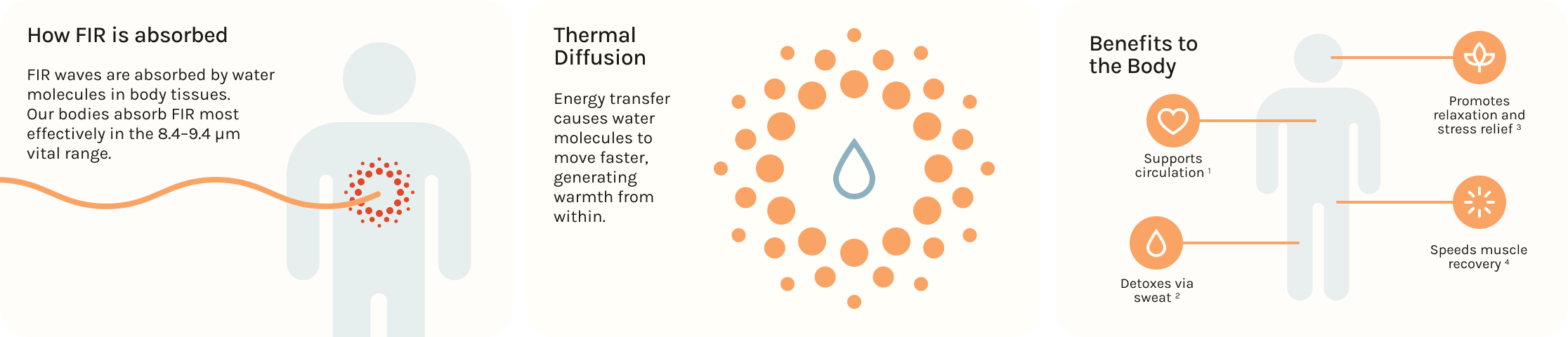
- The wavelengths efficiently absorbed by water molecules, which make up a significant portion of human tissue
Rather than heating the surrounding air, far infrared energy in this range is absorbed by the body more directly, producing a gentle, penetrating warming effect.
Where the Vital Zone Sits on the Electromagnetic Spectrum
Infrared energy exists just beyond visible red light on the electromagnetic spectrum and is commonly divided into three regions:
- Near Infrared (NIR): ~0.7–1.4 µm
- Mid Infrared (MIR): ~1.4–3 µm
- Far Infrared (FIR): ~3–100+ µm
The vital zone lies within the far infrared portion, concentrated around the wavelengths most associated with thermal radiation from warm objects, including the human body itself.
Why the 7–14 Micron Range Is Considered “Vital”
At normal body temperature, the human body emits infrared radiation primarily in the far infrared range, with a peak emission near 9–10 microns.1 This overlap between emitted and absorbed wavelengths is why the 7–14 micron range is often described as biologically resonant or compatible.
Importantly, this does not mean far infrared energy is unique in a mystical sense. It means it behaves in a way that aligns with how warm biological tissue naturally exchanges heat with its environment.
Far Infrared Heat vs. Conventional Heat
- Conventional (Conductive or Convective) Heat
- Warms the surrounding air first
- Heat is transferred to the body secondarily
- Often requires higher ambient temperatures to feel effective
- Far Infrared Radiant Heat
- Transfers energy directly via infrared radiation
- Does not rely on heating the air
- Can feel effective at lower ambient temperatures
This difference in heat transfer explains why far infrared environments often feel gentler yet deeply warming, even when the air temperature is relatively moderate.
How Far Infrared Interacts With the Body
Far infrared radiation in the vital zone is readily absorbed by water molecules and other tissues near the body’s surface. This absorption results in:
- Conversion of infrared energy into thermal energy
- Gradual warming of tissue
- Increased comfort over longer exposure periods
Because this process is radiative rather than convective, the sensation of warmth is often described as more even and less stifling than high-air-temperature heat.
Why Wavelength Matters More Than Intensity Alone
When evaluating infrared heat sources, wavelength distribution matters just as much as power output.
Two heat sources can produce the same temperature but feel very different depending on:
- The wavelengths they emit
- How efficiently those wavelengths are absorbed by the body
- Whether heat is delivered evenly or in concentrated spots
The vital zone concept helps explain why not all infrared heat feels the same, even at similar temperatures.
Common Misunderstandings About the Vital Zone
- It does not imply medical treatment. The vital zone describes wavelength compatibility, not disease treatment or cure.
- It does not mean deeper is always better. Far infrared primarily interacts with surface and near-surface tissues through thermal absorption.
- It is not exclusive to saunas. Any warm object emits far infrared radiation within this range; controlled environments simply make it more noticeable.
Why the Vital Zone Is Relevant in Sauna Design
In far infrared sauna environments, heater materials and operating temperatures influence the wavelengths emitted. Systems designed to emphasize the 7–14 micron range aim to deliver:
- Consistent radiant warmth
- Even heat distribution
- A comfortable thermal experience over time
The focus is less on extreme temperatures and more on how heat is delivered and perceived.
Frequently Asked Questions
- What is the vital zone in simple terms?
It’s the range of far infrared wavelengths (about 7–14 microns) that closely align with the infrared energy naturally emitted and absorbed by the human body. - Is the vital zone scientifically recognized?
The term itself is descriptive, but the underlying physics of infrared emission and absorption are well established. - Does far infrared heat the air?
Not primarily. It transfers energy through radiation rather than heating air first. - Is higher temperature better for far infrared?
Not necessarily. Wavelength and heat delivery often matter more than air temperature alone.