
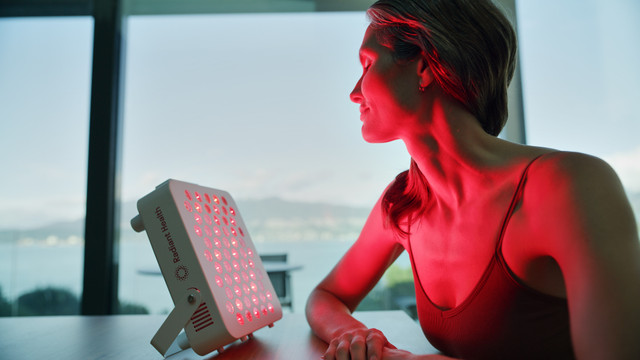
The Benefits of Red, Near-Infrared, and Far-Infrared Light in Sauna Therapy
2026 Jan 14th
Combining red, near-infrared, and far-infrared light can create a layered wellness effect. Red and near-infrared light are studied in photobiomodulation for their potential to support cellular function and recovery, while far-infrared sauna-style heat supports relaxation and circulation through gentle thermal stress.1
1. Understanding the Spectrum
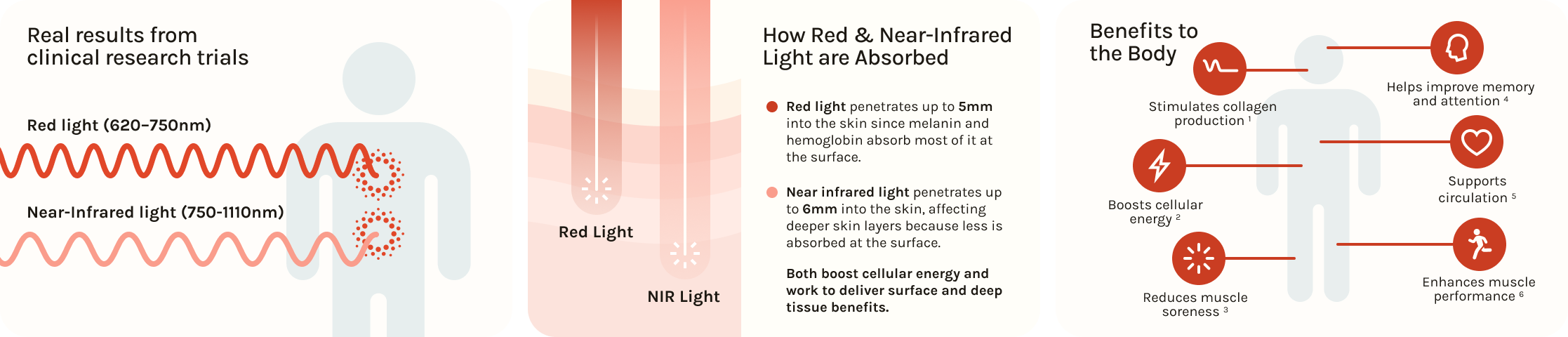
Light interacts with the body in different ways depending on wavelength and depth of penetration, which is why red/NIR effects are typically discussed in cellular terms while FIR is discussed in thermal terms.2
| Light Type | Wavelength Range | Depth of Penetration | Key Effects |
| Red Light (Visible)3 | 620–700 nm | Skin surface | Supports collagen and skin vitality |
| Near-Infrared (NIR)4 | 700–1400 nm | 2–5 mm | Boosts cellular energy and recovery |
| Far-Infrared (FIR)5 | 5000–10000 nm | Up to 1.5 inches | Gently raises core temperature and supports circulation |
Red and near-infrared light primarily act on the skin and cells, while far-infrared provides deeper thermal effects. Together, they encourage the body’s natural ability to restore equilibrium.
2. How Red and Near-Infrared Light Support Cellular Health
Red and near-infrared wavelengths are studied for their interaction with mitochondria, supporting ATP-related cellular energy processes that may influence how the body recovers and adapts.
In performance and recovery contexts, photobiomodulation research suggests these wavelengths may support muscle recovery and functional outcomes following exertion.
For skin wellness, multiple clinical studies have evaluated red/NIR light for measures related to skin texture, appearance, and collagen-associated outcomes.3,6,7
3. The Deep Thermal Benefits of Far-Infrared
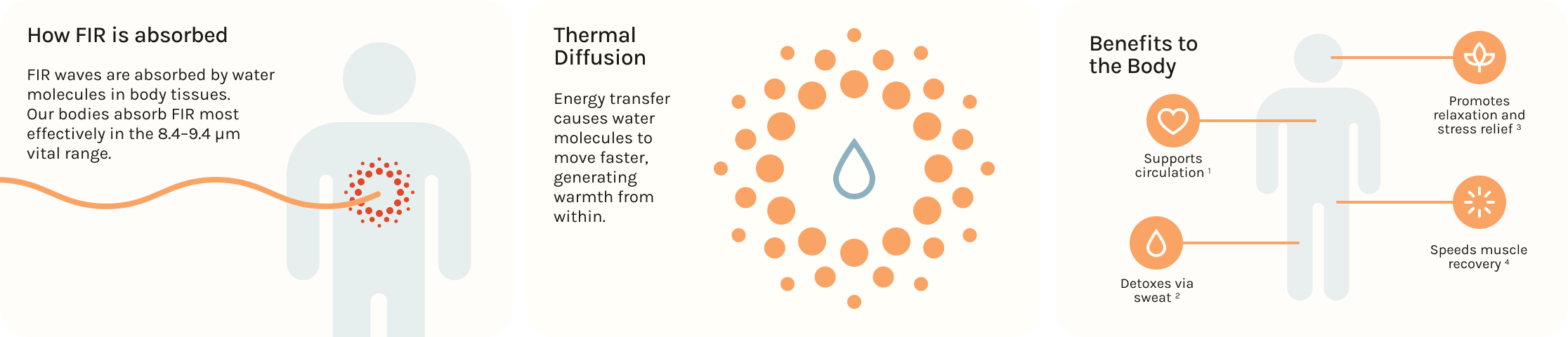
Far-infrared heat works differently than high-heat traditional sauna air heating: rather than relying primarily on hot ambient air, FIR is often described as warming the body through deeper thermal transfer, supporting a comfortable sweat response and relaxation.
Thermal sauna exposure is also associated with cardiovascular-supportive effects in observational and clinical literature, including measures related to vascular function and cardiovascular risk.
Because FIR promotes sweating, some studies have evaluated sweat as one pathway through which certain trace elements may be excreted, which is why “sweat-supported elimination” is a more precise framing than broad “detox” language.8, 9, 10
4. Why the Combination Matters
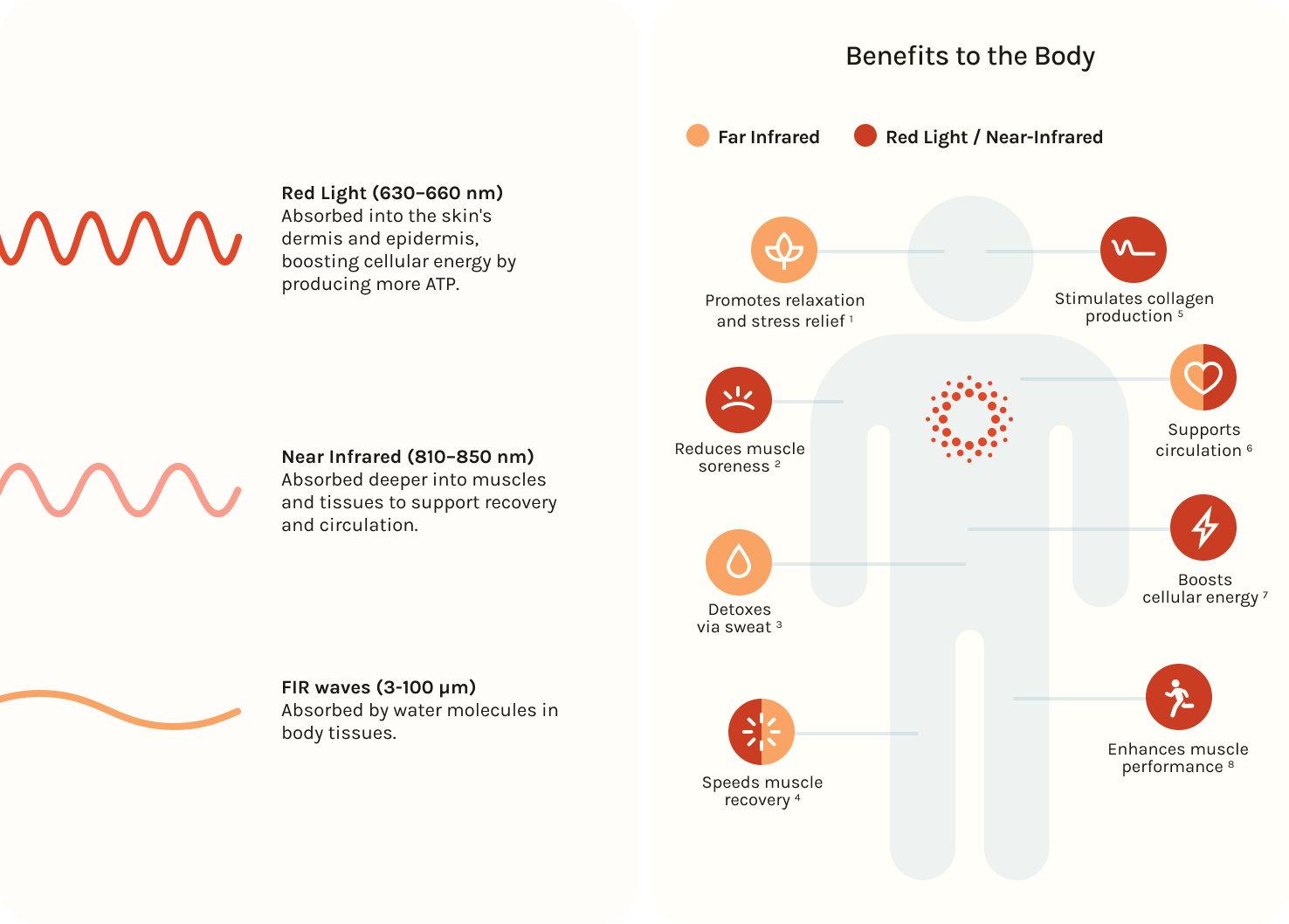
Each wavelength has a distinct mechanism, but they can complement one another as part of a consistent routine: red/NIR supporting cellular-level recovery processes, and FIR supporting relaxation and circulation through gentle thermal stress.1
Research across photobiomodulation modalities suggests benefits can be influenced by consistency and dosing parameters (including wavelength, intensity, and timing), which is why a balanced approach typically outperforms intensity alone.11
- https://pmc.ncbi.nlm.nih.gov/articles/PMC5941775/
- https://pubmed.ncbi.nlm.nih.gov/24258312/
- https://pubmed.ncbi.nlm.nih.gov/22505948/
- https://pubmed.ncbi.nlm.nih.gov/35323210/
- https://pubmed.ncbi.nlm.nih.gov/37522497/
- https://pubmed.ncbi.nlm.nih.gov/19304125/
- https://pubmed.ncbi.nlm.nih.gov/25443662/
- https://pubmed.ncbi.nlm.nih.gov/21814736/
5. Safe and Mindful Use
Across sauna and infrared research, sessions are generally well tolerated when used appropriately, though individual considerations apply and people with underlying conditions should consult a clinician.12
To support an optimal experience:
- Stay hydrated before and after sessions
- Begin with shorter durations (10–20 minutes) and increase gradually
- Allow your body to cool naturally afterward
- Consult a healthcare professional if you have medical implants or underlying conditions
Consistency tends to matter more than intensity, especially when building a long-term wellness practice.
In Summary
Red, near-infrared, and far-infrared light each play a unique role in supporting the body. Used together, they offer a balanced combination of cellular support, deep thermal comfort, and overall restoration grounded in established photobiomodulation and sauna literature.1
FAQs
- Is red light therapy the same as infrared?
No. Red light is visible and primarily affects the skin, while infrared light is invisible and penetrates deeper to create thermal or cellular effects. - Can near-infrared and far-infrared be used together?
Yes. Combining both supports cellular repair (NIR) and full-body relaxation (FIR) for a balanced, restorative session. - Is infrared light therapy safe?
Infrared and red-light therapies are considered safe for most people when used correctly. Hydrate, start slow, and consult your healthcare provider if you have health conditions.
References
- Mechanisms and applications of the anti-inflammatory effects of photobiomodulation
https://pmc.ncbi.nlm.nih.gov/articles/PMC5523874/ - Mitochondrial Mechanisms of Photobiomodulation in Context of New Data About Multiple Roles of ATP
https://pubmed.ncbi.nlm.nih.gov/20374017/ - A Prospective, Randomized, Placebo-Controlled, Double-Blinded, and Split-Face Clinical Study on LED Phototherapy for Skin Rejuvenation
https://pubmed.ncbi.nlm.nih.gov/17566756/ - Low-Level Laser (Light) Therapy Increases Mitochondrial Membrane Potential and ATP Synthesis in C2C12 Myotubes With a Peak Response at 3–6 h
https://pubmed.ncbi.nlm.nih.gov/25443662/ - Clinical Effects of Regular Dry Sauna Bathing: A Systematic Review
https://pmc.ncbi.nlm.nih.gov/articles/PMC5941775/ - Pre-Exercise Infrared Photobiomodulation Therapy (810 nm) in Skeletal Muscle Performance and Post-Exercise Recovery in Humans: What Is the Optimal Power Output?
https://pubmed.ncbi.nlm.nih.gov/29099680/ - Light-Emitting Diode Phototherapy Improves Muscle Recovery After a Damaging Exercise
https://pubmed.ncbi.nlm.nih.gov/24258312/ - Infrared Radiation in the Management of Musculoskeletal Conditions and Chronic Pain: A Systematic Review
https://pubmed.ncbi.nlm.nih.gov/35323210/ - Association Between Sauna Bathing and Fatal Cardiovascular and All-Cause Mortality Events
https://pubmed.ncbi.nlm.nih.gov/25705824/ - Arsenic, Cadmium, Lead, and Mercury in Sweat: A Systematic Review
https://pubmed.ncbi.nlm.nih.gov/22505948/ - Red (660 nm) and Infrared (830 nm) Low-Level Laser Therapy in Skeletal Muscle Fatigue in Humans: What Is Better?
https://pubmed.ncbi.nlm.nih.gov/21814736/ - Infrared Sauna in Patients With Rheumatoid Arthritis and Ankylosing Spondylitis
https://pubmed.ncbi.nlm.nih.gov/18685882/